


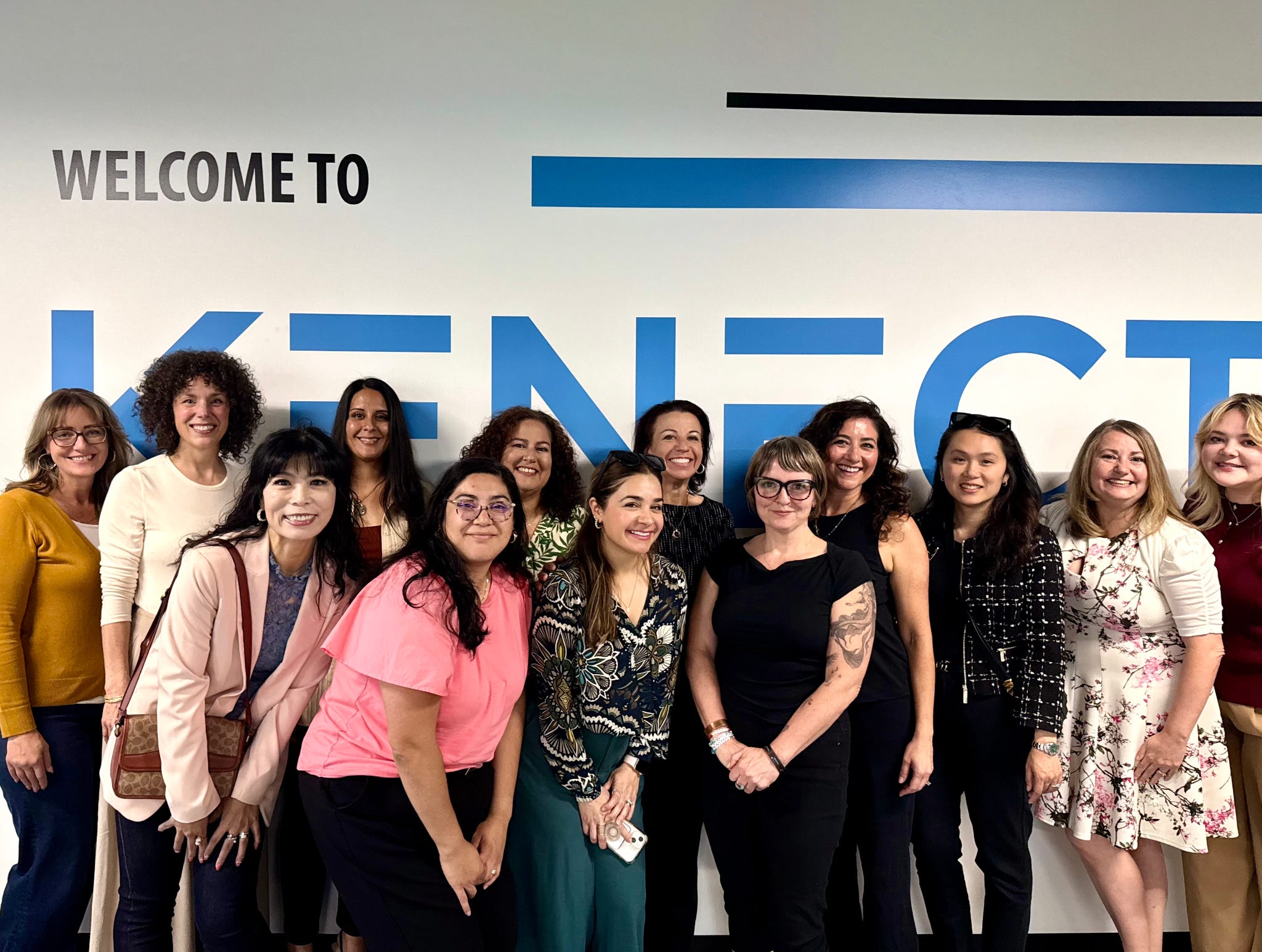
At the close of the Silicon Slopes Women in Leadership Spring Mentorship Cohort, we gathered for a conversation with Rebecca Brockbank on a topic that feels increasingly urgent: what it takes to protect our attention, judgment, and agency in a world moving faster than our brains were built to process.
The session was titled Reclaim Your Brain: How to Manage the Trap of a New Kind of Brain Drain, and it gave language to something many of us are already feeling. AI is changing how we work, learn, create, decide, and lead. It is lowering barriers, expanding access, and making certain kinds of work faster than ever, and affords us new identities in new spaces (hello Builders of Lovable!). It is also introducing a new kind of mental load. More tools. More outputs. More options. More decisions. More pressure to keep up. More temptation to hand over the very parts of our thinking we most need to strengthen.
That tension is where the real conversation lives.
This is not an argument against AI. It is an argument for more intentional leadership in how we adopt it. The current pace of AI acceleration is often framed around productivity, efficiency, and competitive advantage, but too many of those conversations skip over the human system being asked to absorb the change. Companies are rolling out tools, hosting trainings, sharing prompts, and telling people to experiment. Those things may be useful, but they are not enough. AI adoption is not just a technology initiative. It is a behavior-change challenge.
That distinction matters because humans do not change simply because a better tool exists. We change through practice, repetition, feedback, emotional safety, social learning, and the slow work of building new pathways that eventually become familiar enough to trust. The brain is designed for efficiency. It returns to what it knows, especially under stress. When we are anxious, overloaded, or overstimulated, we do not become more adaptive. We tend to grip harder to the pathways that already exist.
Rebecca’s expertise sits at the intersection of learning science, cognitive and behavioral science, adult learning, emotion regulation, and human capacity development. That background shaped the heart of the discussion: if we want people to use AI well, we have to understand how people actually learn. We have to account for cognitive load, fear, overwhelm, identity disruption, and the very real discomfort that comes with building a new way of working before it feels natural.
One of the most important ideas we discussed was cognitive load, which is the mental effort required to process information, make decisions, and learn something new. AI can absolutely reduce cognitive load when it helps us summarize, organize, compare, draft, or see patterns. But AI can also increase cognitive load when the user is still learning how to evaluate the quality, accuracy, usefulness, and ethics of what comes back. For novice learners especially, AI can create the illusion of ease while quietly removing the productive struggle that real learning requires.
That productive struggle matters. We need friction. We need to wrestle with ideas. We need to form a point of view before outsourcing the polish. We need to test our assumptions, sit with ambiguity, make judgments, and revise our thinking. A tool that gives us an answer quickly can be useful. A tool that trains us out of thinking carefully is a problem.
This is especially true when AI systems are built to be agreeable. When a tool constantly validates our framing, mirrors our language, and smooths away the discomfort of being challenged, it may feel helpful in the moment while weakening the conditions required for deeper learning. Human growth often requires moderate difficulty. It requires correction. It requires tension. It requires the occasional discomfort of realizing our first thought was not our best thought.
In that sense, one of the risks of AI is not that it becomes too powerful. It is that we become too passive.
The question for leaders is not simply how to get people using AI faster. The better question is how to help people use AI without surrendering their judgment to it. How do we protect discernment, voice, ethical reasoning, creative struggle, and self-trust while also benefiting from the speed and scale these tools provide? How do experienced workers stay current without compromising the instincts they have spent years developing? How do early-career workers build real expertise when AI can help them produce work that looks mature before their judgment has caught up?
These are not side questions. They are the people plan.
For women in leadership, this conversation carries a particular kind of weight. Women are often already doing the invisible work of translating ambiguity, regulating rooms, mentoring others, absorbing emotional labor, and building credibility inside systems that have not always recognized their authority evenly. AI disruption adds another layer to that reality. It can open doors, accelerate access, and expand creative possibility. It can also create more pressure, more noise, and more opportunities for people to mistake output for wisdom.
That is why reclaiming the brain is not just a productivity conversation. It is an agency conversation.
It asks us to protect the capacities that make our leadership meaningful: attention, discernment, relational presence, judgment, creativity, and the courage to trust what we know. It also asks us to stop pretending that individuals can self-optimize their way through systemic change alone. Humans learn in relationship. We build confidence through supported practice. We regulate better when we are not isolated. Mentorship, sponsorship, peer learning, and community are not “nice to have” supports in this era. They are part of the infrastructure of adaptation.
A human-centered future of work will not be built by tools alone. It will require organizations to design for how people actually learn and change. That means smaller learning loops, safer practice environments, guided experimentation, real scaffolding, and leadership that understands the difference between exposure and adoption. It means helping people regulate the emotional load of change, not shaming them for feeling it. It means creating room for people to build fluency over time instead of pretending a single training can rewire years of habit.
It also means resisting the strange cultural pull to anthropomorphize AI into something more human than it is. We do not need to give these tools cute names, genders, emotional authority, or social status in our lives. We do not need to feel guilty for being direct with a machine. We do not need to confuse fluency with friendship or confidence with competence. AI cannot marginalize us on its own. People and systems do that. Which means people and systems carry the responsibility to choose differently.
This is also why Pope Leo XIV’s recent statements on AI and humanity feel so relevant to this conversation. His message is not that technology should be rejected. It is that technology must be put back in its proper place. In his first encyclical, Magnifica Humanitas, he writes about the need to “disarm” AI, not by stopping innovation, but by refusing to let technical power become a form of domination. That distinction matters. The question is not whether AI will become part of our work. It already has. The question is whether we will shape it with enough moral clarity, human judgment, and social responsibility to keep people from becoming secondary to the systems built to serve them.
That lands directly inside the work of leadership. If the challenge of AI is not merely technological, but human, then our response cannot be limited to tools, trainings, and productivity targets. We have to ask better questions about attention, dignity, freedom, learning, and care. We have to stop confusing access to information with wisdom, output with judgment, and speed with progress. A human-centered AI strategy has to preserve the human capacities that make work worth doing in the first place.
One line from the conversation stayed with me: we have to take our brains to the gym.
That feels like the work now. Not panic. Not hype. Not passive adoption dressed up as innovation. Practice.
We need the reps that keep our attention strong. We need the habits that keep our judgment active. We need the reflection that keeps our voice intact. We need the courage to use AI without disappearing into it.
The future of work will not be shaped only by what AI can do. It will be shaped by what humans continue to practice, protect, and value.
That is why we reclaim the brain.
Not because we are afraid of the future, but because we intend to lead it with our humanity still intact.
Learn more about Rebecca, her work, and her latest writing on AI Adoption and the Human Experience, follow her at: https://www.linkedin.com/in/rebecca-brockbank/

